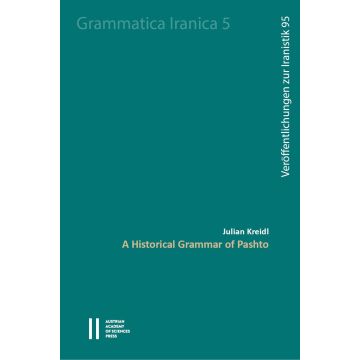
A Historical Grammar of Pashto
€50.87
incl. VAT
currently out of stock
Delivery in 7 to 14 business days
Tags
Pashto, the second-most spoken language within the Iranian language family, remains strikingly underrepresented in historical linguistic scholarship. This study offers a systematic overview of the historical development of the phonology, morphology, and syntax of Pashto, addressing critical gaps in the field.
Despite the language’s significance both linguistically and geopolitically as a lingua franca of the Hindukush area comprehensive research on both its synchronic grammar and diachronic development remains surprisingly sparse. While the endpoints of its evolution – Proto-Iranian and contemporary Pashto – are occasional subjects of research, the intermediary stages are far less understood. This work addresses this lacuna by exploring key stages of linguistic change, offering insights into what may be termed “Middle Pashto”, and considering its implications for the internal classification of Eastern Iranian languages.
The study also serves a consolidating function: it brings together and contextualizes the dispersed yet foundational contributions of scholarly pioneers on Indo-Iranian Hindukush languages, whose works remains pivotal but often inaccessible due to their distribution across numerous articles and monographs. By synthesizing this body of research, the volume seeks to make these important insights more visible and usable for contemporary scholarship.
This work will be of particular value to linguists specializing in Iranian languages, historical and comparative linguistics, and the study of language contact in the Hindukush region. It invites further research into an area that is as linguistically rich as it is underexplored.
Weight:
439 g
Author:
EAN:
9783700193418
hoehe_mm:
240
breite_mm:
170
Year of publication:
2026
Write Your Own Review
Manufacturer
Name: Verlag der Österreichischen Akademie der Wissensch
Address: Dr. Ignaz Seipel-Platz 2, 1010 Wien, Österreich
Email: verlag@oeaw.ac.at
Phone: +43 1 51581 3420
Responsible for the EU
Name:
Address:
Email:
Phone:
Hazard warning:
Product Type: